

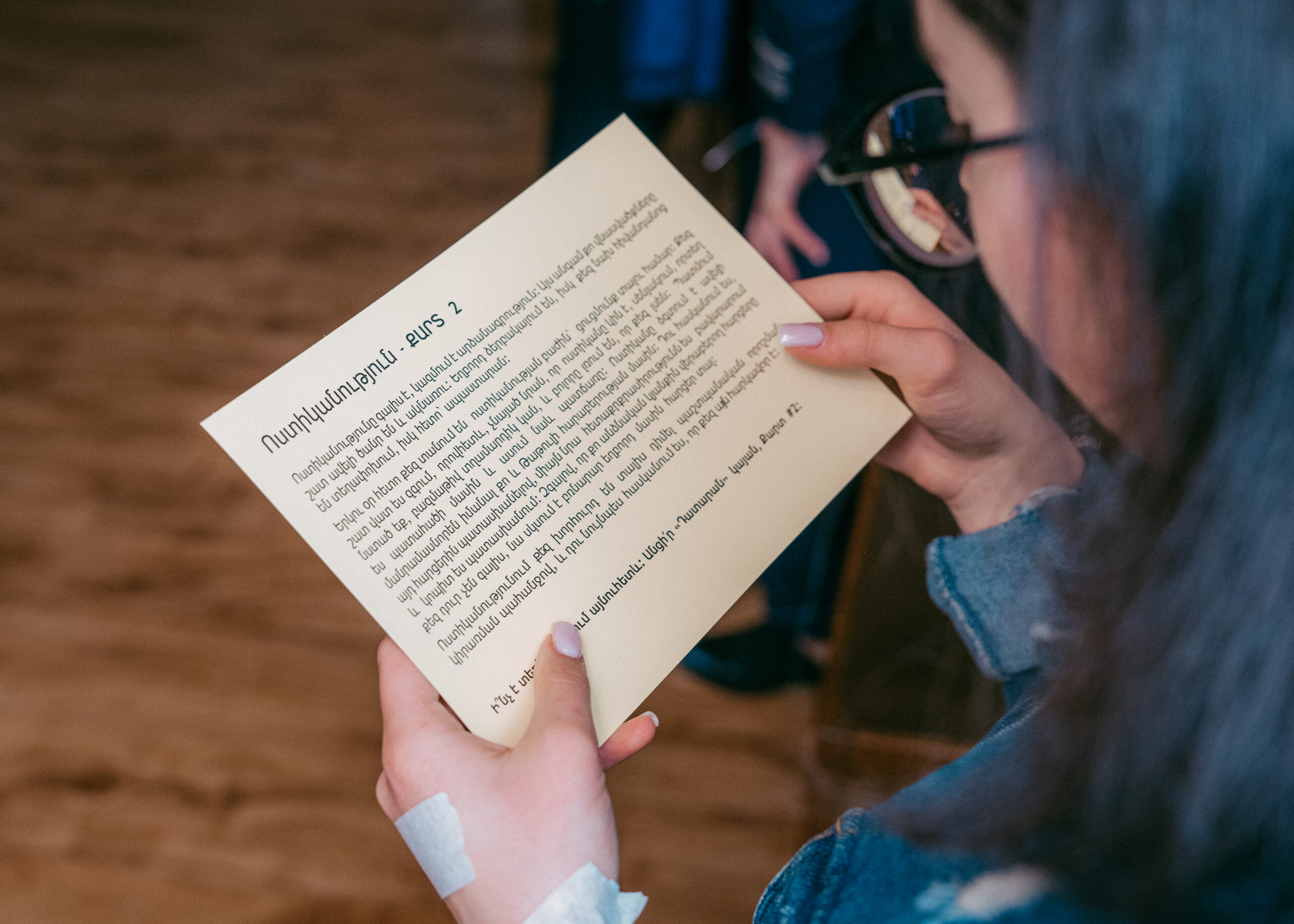
“Violence begins when a person is no longer seen as whole—as someone with potential, as an equal,” says Sergo Ayvazyan, a participant in the “In Her Shoes” project simulation game.
The “In her shoes” project aims to shift community perceptions about violence against women and girls by using the powerful tool of behavioral simulation as an educational and awareness-raising method.
“The simulation, among other cases of violence, also addresses the case of violence against a woman with a disability, highlighting her particularly vulnerable situation and the difficulties in finding solutions. The exercise allows participants to ‘put themselves in her shoes,’ ” added the training coordinator Narine Asatryan.
During the exercise, Sergo explored a case involving a woman with a disability who had experienced violence. He highlighted a crucial and often overlooked dimension—violence is not only physical. When someone’s voice isn’t heard, when their opinion is ignored, when they’re constantly cast in the role of the one who needs help—that, too, is systemic violence.
“In the simulation, no one saw the woman as someone capable of making independent choices or taking responsibility. Her surroundings—her husband, the priest, the psychologist—they all made decisions for her. They told her to stay quiet, to endure, to adapt. No one asked, ‘What do “you” want?’ The exercise showed how society—from close relatives to professionals—often fails to distinguish between support and help. And this distinction is what determines whether a person ends up feeling like a victim, or reclaims their agency.
Whether someone has a disability or not, guidance must be right, and help must be targeted.”
Sergo emphasized that, in real life, people with disabilities are often the ones expected to yield, to remain silent, to be patient. Society excuses this with words like compassion and endurance, but in reality, it creates a space where violence is tolerated.
“Society is not ready for true inclusion, yet we put all the responsibility on people with disabilities—to integrate, to adjust. But the real question is: “Are we ready to accept, to listen, to understand?”
This experience became a turning point—not just a case analysis, but a mirror reflecting how harmful messages are often delivered even by professionals, due to a lack of knowledge about the specific realities of people with disabilities. And it is precisely this lack of understanding that often leaves survivors without real solutions.
“Until every voice is heard, no one is truly protected,” he concluded, stressing the importance of safe spaces and the need for ongoing conversations like this one.
This initiative is carried out by OxYGen Foundation in the framework of the “EU 4 Gender Equality: Together against gender stereotypes and gender-based violence” programme (phase 2), funded by the European Union, implemented jointly by UN Women and UNFPA.
This article was produced with the financial support of the European Union. Its contents are the sole responsibility of UN Women and UNFPA and do not necessarily reflect the views of the European Union.
